And Why Every Teacher Can Make a Greater Impact Through Structured Literacy
If you’ve been teaching for any length of time, you’ve almost certainly taught a student who found reading far more difficult than their classmates.
They weren’t the children who lacked curiosity or motivation. In fact, they were often the ones who worked the hardest. They listened carefully during every lesson, joined in classroom discussions and genuinely wanted to succeed, yet reading never seemed to become easier. Some guessed unfamiliar words because decoding was exhausting. Others could read accurately but struggled to explain what they had just read. Over time, many began to lose confidence, quietly deciding that perhaps reading simply wasn’t something they were ever going to be good at.
Those students stay with us.
Long after they’ve left our classroom, we still remember them because we know how capable they were. We remember celebrating the smallest gains, trying different approaches and wondering whether there was another strategy we hadn’t yet explored that might have made the difference.
For many teachers, those students become the reason they begin looking more deeply into how children learn to read.
Over the past decade, literacy education has undergone significant change. As our understanding of reading development has grown, so too has the research supporting explicit, systematic literacy instruction. Across Australia, schools are investing in evidence-informed practice, reviewing literacy programs and encouraging teachers to deepen their understanding of the Science of Reading. What was once considered specialist knowledge is increasingly becoming essential knowledge for every educator working with children.
This shift isn’t about following another educational trend or replacing one program with another. It’s about recognising that when we understand how reading develops, we are better equipped to recognise why some students struggle and, more importantly, how we can help them succeed.
As a result, educators with specialist literacy knowledge are becoming increasingly valuable in schools, intervention settings and tutoring practices. Whether you’re a classroom teacher, a learning support teacher, an intervention specialist or a tutor, developing a deeper understanding of Structured Literacy provides opportunities not only to strengthen your own teaching, but also to make a lasting difference to the students who need that expertise most.
What Does a Literacy Specialist Actually Do?
When people hear the term literacy specialist, they often assume it simply means someone who teaches phonics.
In reality, the role is much broader than that.
A literacy specialist understands how the different components of reading and writing work together. They know how to identify where a student’s difficulties lie, use assessment to guide instruction and plan lessons that build skills in a logical, systematic way. Rather than applying the same intervention to every struggling reader, they understand that every student arrives with a different learning profile and that effective instruction begins with understanding those individual needs.
Their work draws on knowledge across phonological awareness, phonics, fluency, vocabulary, morphology, syntax and reading comprehension. Just as importantly, they understand how these areas influence one another. A student struggling with comprehension may have a limited vocabulary. Another who reads accurately but slowly may require fluency instruction before comprehension can improve. A literacy specialist learns to look beyond the surface and ask better questions about what is preventing a student from becoming a confident reader.
That way of thinking changes classroom practice.
Instead of asking, “Why isn’t this child keeping up?”, teachers begin asking, “Which skills does this student need to develop next?”
It might seem like a small shift in language, but it fundamentally changes the way we approach teaching. Assessment becomes a tool for planning rather than simply measuring progress, and intervention becomes purposeful rather than reactive.
Looking Beyond Phonics
One of the most interesting conversations we have during our workshops is about what happens after students become reasonably accurate decoders.
Many teachers describe children who can read the words on the page quite well, yet still struggle to understand what they have read. Others talk about students who avoid using sophisticated vocabulary in their writing or become overwhelmed when they encounter longer, unfamiliar words in subjects such as Science or History.
These experiences often lead us to another important aspect of Structured Literacy that doesn’t always receive the attention it deserves: morphology.
Morphology is the study of the meaningful parts of words. Rather than treating every new word as something students need to memorise, morphology helps them understand how words are constructed using base words, prefixes and suffixes.
Once students begin recognising those patterns, something interesting happens.
Instead of approaching every unfamiliar word as a completely new challenge, they begin looking for clues they already know.
They recognise a familiar base word.
They identify a prefix that changes meaning.
They notice a suffix that changes the word’s function.
Reading becomes less about memorising thousands of individual words and more about understanding how English works.
That understanding has a significant impact on vocabulary development, spelling, and reading comprehension, particularly as students move into the upper primary years, when academic vocabulary becomes increasingly complex.
One simple example illustrates this beautifully.
Take the word transport.
Rather than teaching it as one vocabulary word, invite students to explore related words they already know.
They might suggest:
- transport
- transporting
- transported
- transportation
- transportable
- transporter
The discussion that follows is often far more valuable than simply writing definitions. Students begin to notice that while the base word remains consistent, prefixes and suffixes change its meaning or grammatical function. Without realising it, they are developing a much deeper understanding of vocabulary than they would by memorising each word individually.
This is one of the reasons morphology has become such an important component of Structured Literacy. It helps students build connections between words, recognise patterns across different learning areas and approach increasingly complex vocabulary with greater confidence.
And perhaps one of the most encouraging things about teaching morphology is that it doesn’t require a complete overhaul of your literacy program. Many of the most effective activities are simple and engaging and can be introduced into your classroom almost immediately.
In the next section, we’ll explore some practical strategies that teachers consistently tell us have transformed the way they teach vocabulary, spelling and reading comprehension.
Bringing Structured Literacy Into the Classroom
One of the things teachers often tell us after learning about Structured Literacy is how relieved they feel.
Many arrive expecting to completely rethink everything they’ve ever done in their literacy block. Instead, they discover that effective literacy instruction isn’t about throwing away what already works. It’s about making small, purposeful changes that help students better understand how our language works.
The most effective classrooms aren’t necessarily the ones with the most elaborate resources or the newest programs. They’re the classrooms where teachers consistently teach explicitly, provide opportunities for guided practice and help students make connections between what they’re learning and what they already know.
That’s one of the reasons we love sharing practical classroom strategies. They don’t require expensive resources, hours of preparation or a complete curriculum overhaul. Most can be introduced gradually and adapted to suit students across a range of year levels.
The following activities are ones we regularly demonstrate during our professional learning workshops because they consistently help teachers see how Structured Literacy can be embedded into everyday classroom practice.
Practical Strategy One: Build Word Families
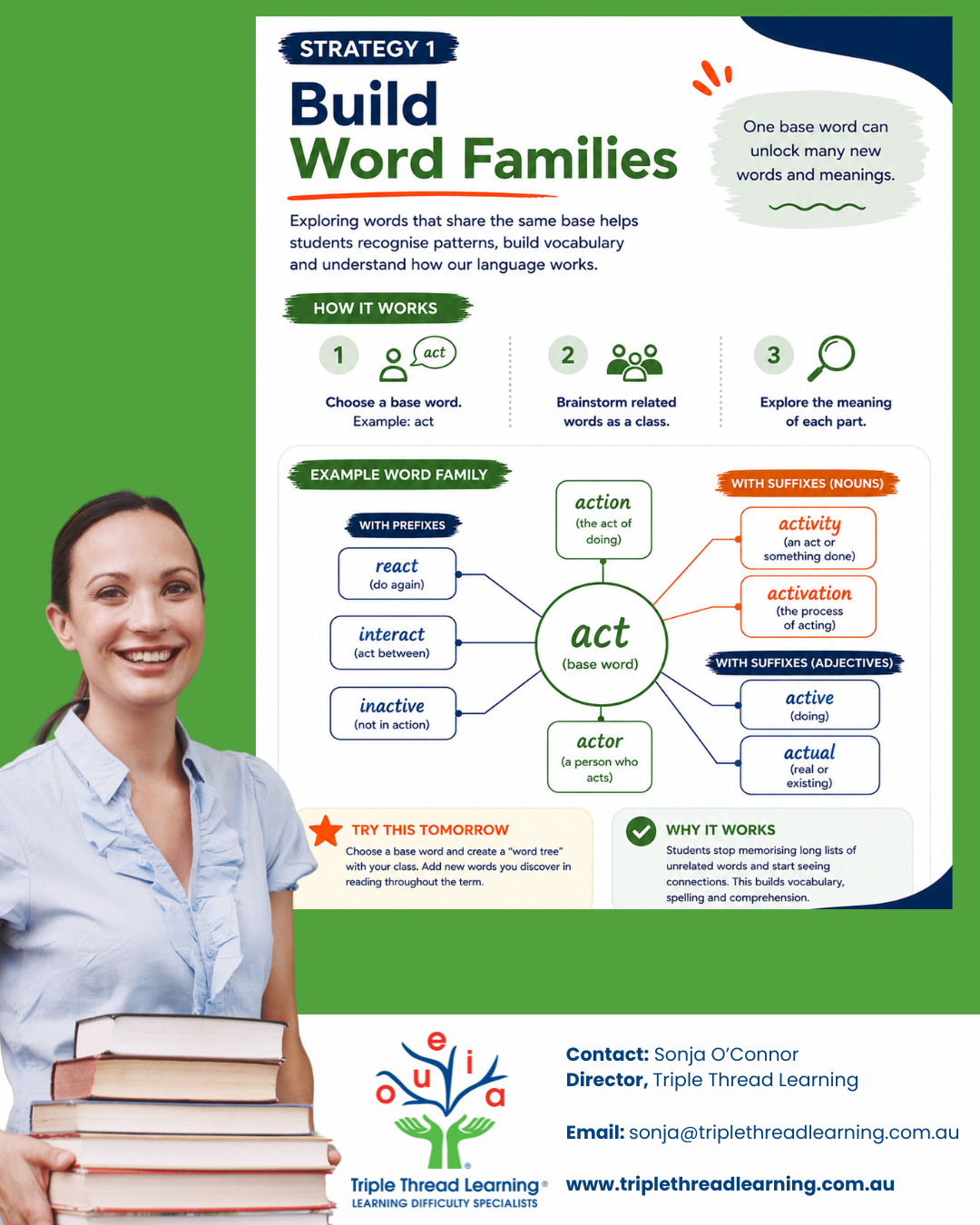
One of the simplest ways to begin exploring morphology is by creating word families.
Rather than introducing vocabulary as a collection of unrelated words, students investigate how multiple words are connected through a shared base word. This helps them recognise that many English words are built from familiar patterns rather than being completely new words to memorise.
For example, begin with the base word act.
Invite students to brainstorm every related word they can think of.
They might generate:
- act
- action
- active
- activity
- activate
- actor
- reaction
- inactive
- interaction
At first glance, this might appear to be a straightforward vocabulary exercise. However, the real learning happens during the discussion.
Ask questions such as:
- What stays the same in every word?
- Which part changes?
- How does adding inter- change the meaning?
- Why is activity a noun while active is an adjective?
- Which words could we use in a Science lesson? Which might appear in English?
Students quickly begin recognising that understanding one base word gives them access to many more words.
Instead of memorising vocabulary, they’re learning how vocabulary is constructed.
Why this works
Word families strengthen far more than spelling.
They develop vocabulary knowledge, improve reading comprehension and help students recognise patterns across subjects. Students who understand how words relate to one another are better equipped to decode unfamiliar vocabulary because they begin looking for meaningful parts they already recognise.
Try this tomorrow
Choose a familiar base word and create a Word Tree with your class.
Write the base word in the centre of a large sheet of paper and invite students to add related words as branches. Use different colours to identify prefixes, base words and suffixes.
Keep adding to the tree throughout the term whenever students discover another related word in their reading.
You’ll be surprised how often students begin referring back to it independently.
Practical Strategy Two: Word Manipulation
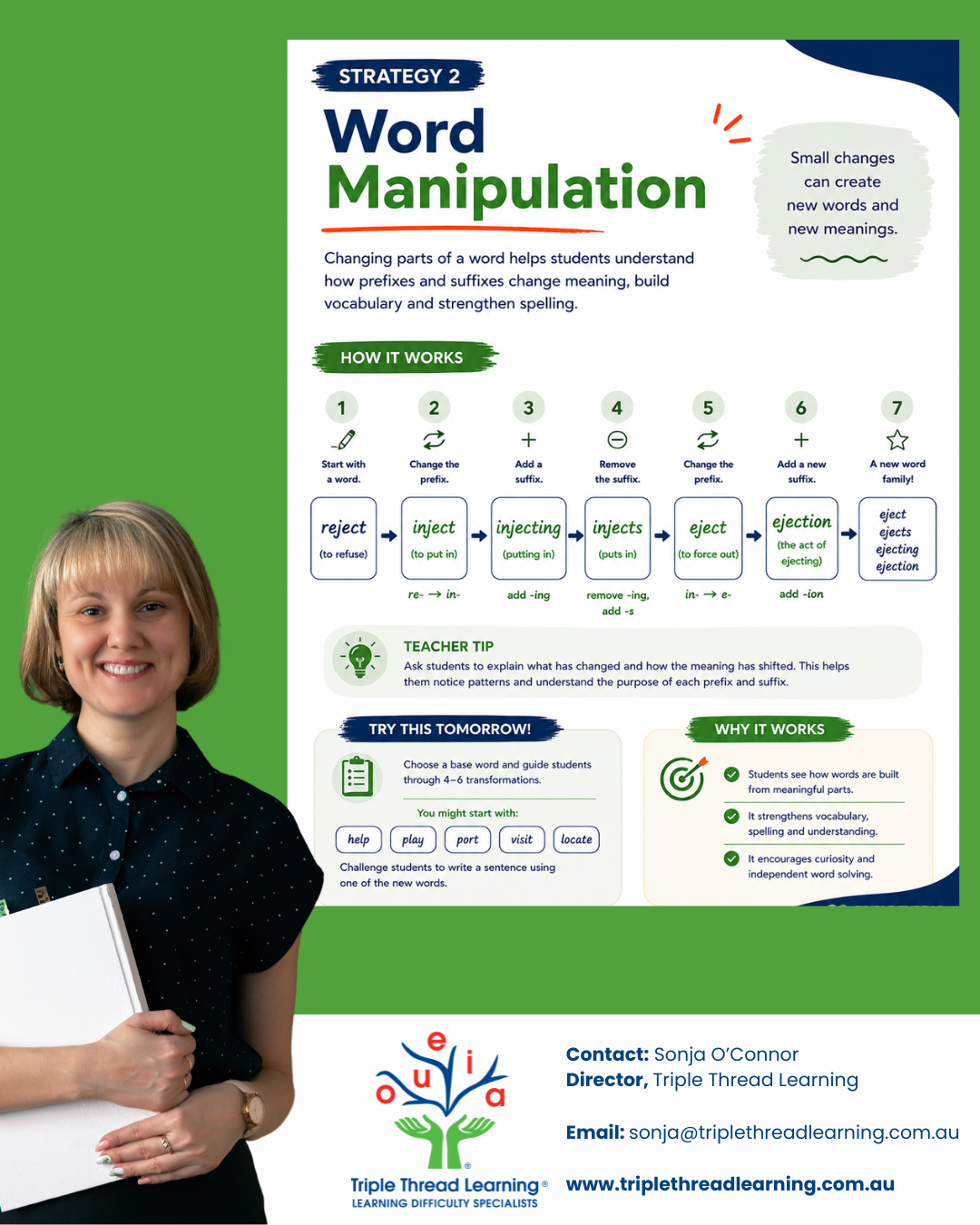
Another activity that teachers often tell us becomes an instant classroom favourite is word manipulation.
Students naturally enjoy solving puzzles, and this activity encourages them to experiment with language while strengthening both spelling and vocabulary.
Begin with a simple word, such as “reject”.
Rather than asking students to spell it repeatedly, challenge them to transform it one step at a time.
Change re- to in-.
The word becomes inject.
Now add -ing.
The word becomes injecting.
Remove -ing and replace it with -s.
Now it’s injects.
Change the prefix again.
Eject.
Finally, add -ion.
Ejection.
As students manipulate each word, encourage them to discuss what has changed.
How has the meaning shifted?
What does the new prefix tell us?
Can they think of another word using the same pattern?
Activities like this encourage students to become curious about language rather than simply memorising it.
One of the most rewarding moments is hearing students begin making connections without prompting.
“It’s like projector!”
“That’s the same ending as collection!”
“They both come from the same base word.”
Those observations tell us students are beginning to recognise patterns for themselves.
Practical Strategy Three: Becoming Prefix Detectives
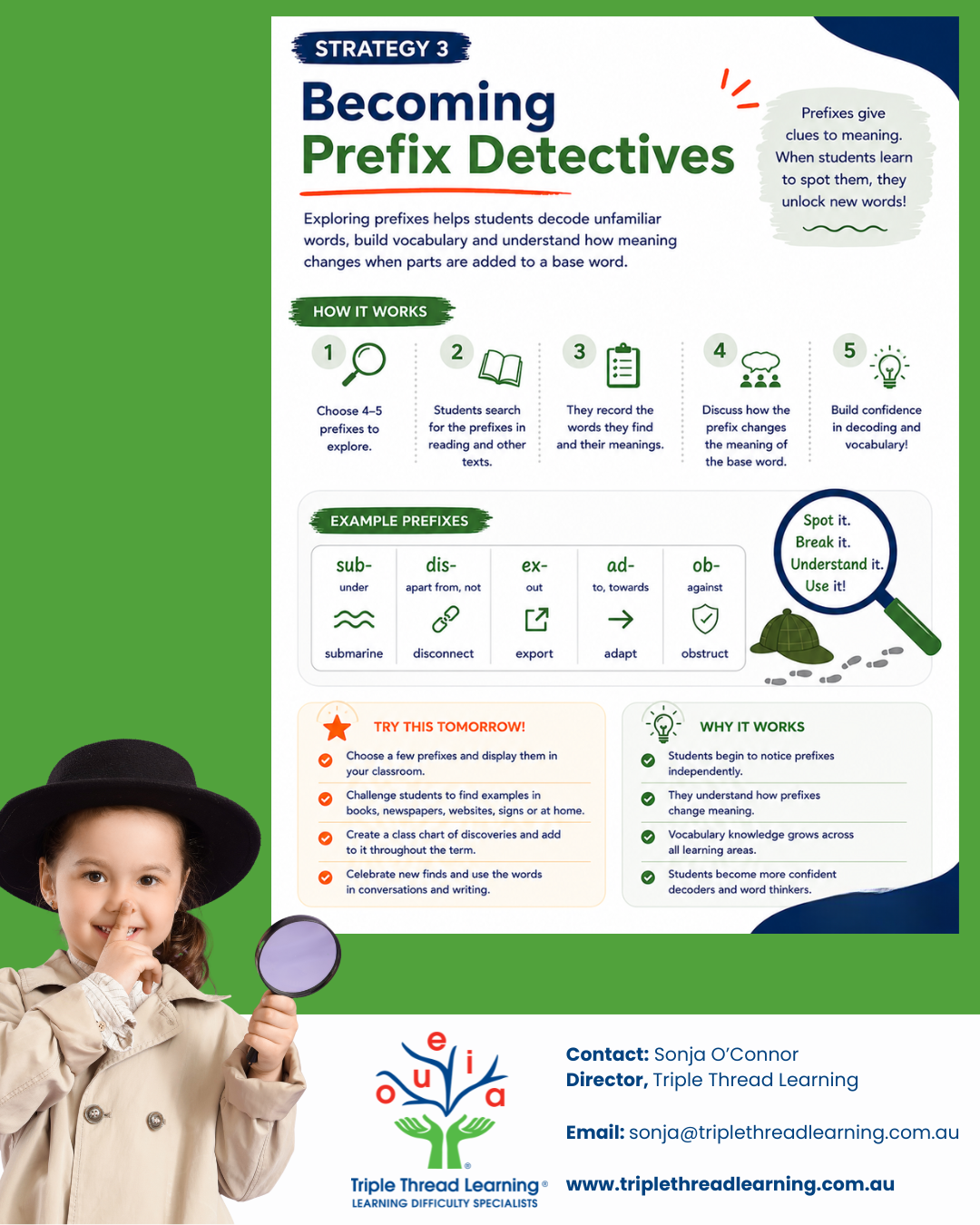
Children love looking for clues, so why not turn vocabulary into an investigation?
Instead of introducing prefixes through a worksheet, challenge students to become Prefix Detectives.
Choose four or five prefixes you would like students to explore.
For example:
| Prefix | Meaning | Example |
|---|---|---|
| sub- | under | submarine |
| dis- | apart from, not | disconnect |
| ex- | out | export |
| ad- | to, towards | adapt |
| ob- | against | obstruct |
Over the next few days, encourage students to search for words containing these prefixes wherever they encounter them.
They might discover them while reading a class novel, during a Science lesson, on classroom displays or even at home.
Once they’ve found examples, invite discussion.
What does the prefix mean?
How does it change the meaning of the base word?
Can you think of another word using the same prefix?
Very quickly, students begin recognising that prefixes aren’t random additions to words.
They carry meaning.
That understanding gives students another tool for unlocking unfamiliar vocabulary independently.
Practical Strategy Four: Bringing Morphology to Life
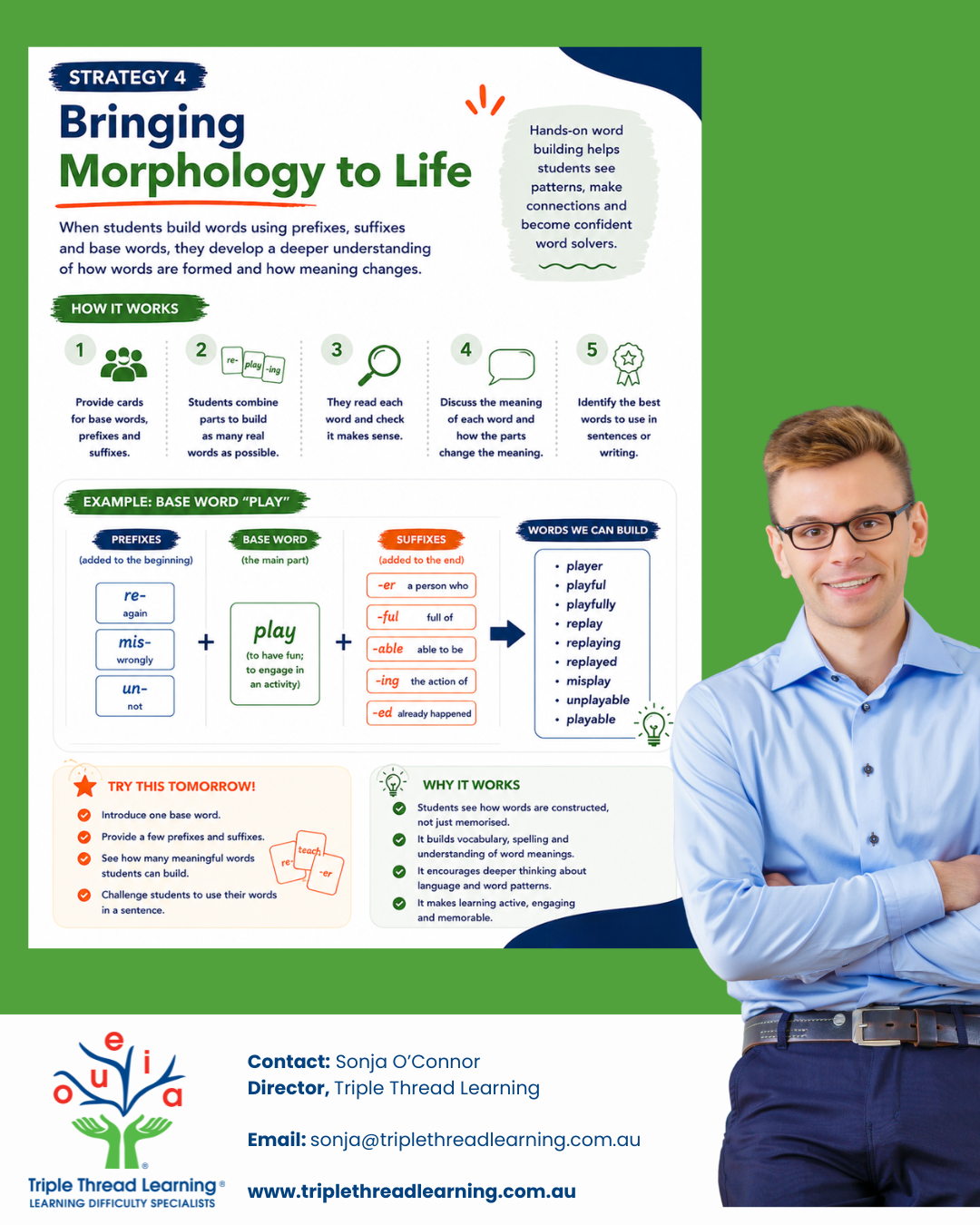
One of the most engaging morphology activities we use during workshops involves simple word cards.
Provide students with a set of base words, prefixes, and suffixes on individual cards, and ask them to build as many real words as possible.
For example, begin with the base word play.
Students might create:
- player
- playful
- playfully
- replay
- replayed
- replaying
- playable
- misplay
The conversation that follows is often where the richest learning occurs.
Why does “playable” make sense but “misplayer” doesn’t?
Which words belong to the same family?
How does each affix change meaning?
These discussions encourage students to think deeply about language while developing a much stronger understanding of vocabulary and spelling.
Perhaps most importantly, they’re actively involved in constructing language rather than simply recording answers on a worksheet.
That hands-on experience makes learning memorable.
Practical Strategy Five: Morphology Journals
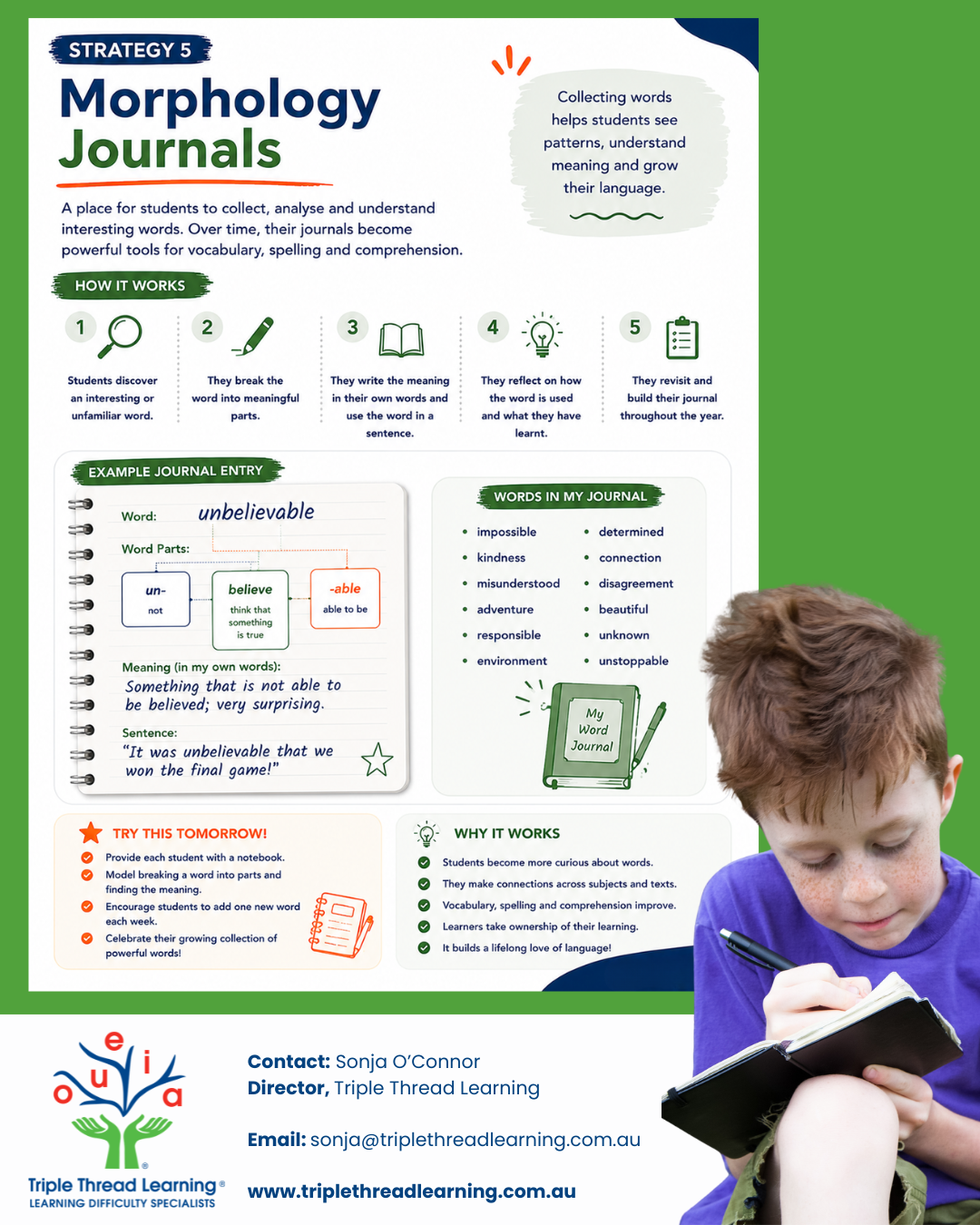
Another strategy that teachers frequently tell us becomes a favourite is introducing a Morphology Journal.
Every student keeps a dedicated notebook where they collect interesting words throughout the year.
Whenever they discover an unfamiliar word, they break it into meaningful parts.
For example:
unbelievable
Prefix: un- (not)
Base word: believe
Suffix: -able (capable of)
Students then explain how each part contributes to the word’s meaning before writing the definition in their own words.
Over time, these journals become far more than vocabulary books.
They become evidence of growing understanding.
Students begin noticing patterns across literacy, Science, history, and Geography because academic vocabulary often shares common roots, prefixes and suffixes.
Teachers frequently tell us that students begin bringing words from home, television and sport because they’ve started looking at language differently.
That’s exactly what we hope to see.
Learning has moved beyond the literacy lesson and become part of how students make sense of the world around them.
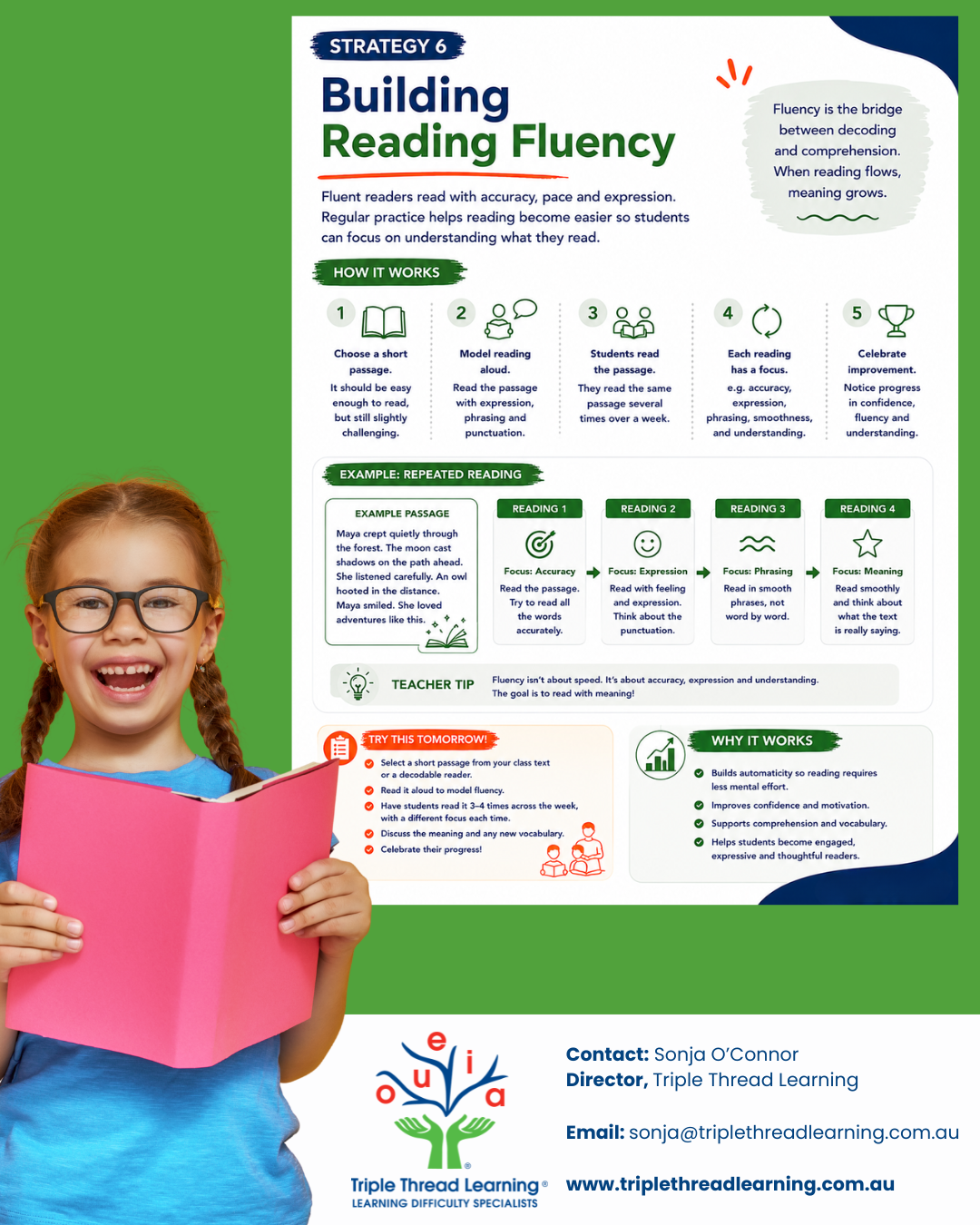
Practical Strategy Six: Building Reading Fluency
While morphology strengthens vocabulary and helps students make sense of increasingly complex words, fluency provides the bridge between decoding and comprehension. It’s an area of literacy that is sometimes overlooked because students may appear to read accurately yet still struggle to fully understand what they have read.
Fluent readers don’t simply recognise words correctly. They read with an appropriate pace, expression, and phrasing, allowing their cognitive energy to focus on understanding the text rather than decoding each word. When reading is slow and effortful, comprehension often suffers because students are concentrating so hard on recognising the words that there is very little mental capacity left to think about meaning.
The encouraging news is that fluency can be improved through regular, purposeful practice.
One strategy we frequently recommend is repeated reading. Choose a short passage that students can decode successfully but still find slightly challenging. Read the passage aloud first, modelling expression and phrasing before inviting students to practise reading it several times over the course of a week.
Each reading has a different focus.
The first may concentrate on accuracy.
The second is expression.
The third is phrasing and smoothness.
By the fourth reading, many students notice that reading feels easier and their understanding of the passage has deepened.
Repeated reading is sometimes misunderstood as simply reading the same text over and over. In reality, it is about building automaticity while continually discussing meaning, vocabulary and punctuation. The goal is never to read as quickly as possible. The goal is to read confidently enough that meaning comes naturally.
Try This Tomorrow
Choose a short passage from your current class novel or decodable text and pair students together.
Student A reads one paragraph while Student B listens for expression, punctuation and accuracy. Rather than correcting every mistake, encourage students to provide one piece of positive feedback before swapping roles.
Simple routines like this build confidence while making reading a shared experience rather than a performance.
Small Changes Often Lead to Big Results
One of the most reassuring things teachers discover when they begin exploring Structured Literacy is that meaningful change doesn’t usually happen through one enormous shift in practice.
Instead, it happens through lots of small decisions made consistently over time.
You might begin introducing one morphology activity each week.
You might replace one traditional spelling lesson with a word investigation.
You might spend ten minutes exploring prefixes before beginning guided reading.
You might encourage students to keep a morphology journal throughout the year.
Individually, these changes appear quite small.
Collectively, they begin transforming the way students think about language.
Rather than viewing reading and spelling as isolated skills, students start recognising the patterns that connect them. They become more curious about words, more willing to tackle unfamiliar vocabulary and increasingly confident in their own ability to solve problems independently.
For teachers, these changes are equally significant. Understanding why a strategy works makes it much easier to decide when to use it, how to adapt it and which students are most likely to benefit.
That confidence is one of the reasons so many educators continue developing their knowledge long after they leave university.
Teaching is a profession built on lifelong learning, and literacy is an area where our understanding continues to evolve.
What Teachers Tell Us After Our Training
One of the privileges of working with educators from across Australia is hearing what happens once they return to their classrooms.
Every teacher arrives with different experiences, different students and different challenges. Some are classroom teachers looking to strengthen whole-class literacy instruction. Others work in intervention, learning support or tutoring. Many simply arrive wanting a better understanding of why some students continue to struggle despite everyone’s best efforts.
Although their experiences are different, the reflections they share afterwards are remarkably similar.
One of the comments we hear most often is:
“I wish I’d learnt this years ago.”
It’s not because teachers haven’t been working incredibly hard. Quite the opposite. Most educators have spent years trying everything they can think of to support struggling readers. What many describe is finally understanding the why behind effective literacy instruction.
One participant reflected:
“Understanding the ‘why’ behind dyslexia and phoneme retrieval has had a real impact on my lesson delivery.”
Another shared:
“The workshop was incredible. Highly engaging, very informative and very supportive.”
Others tell us that seeing literacy instruction modelled in authentic classroom settings helped everything finally make sense.
“Watching lessons and building on skills and ideas made everything click.”
We also hear teachers describe a renewed sense of confidence. Rather than leaving with pages of notes they may never revisit, they leave with practical ideas they’re excited to implement on Monday morning.
For us, that’s always been the goal.
Professional learning should do more than share research.
It should give teachers the confidence to translate that research into meaningful classroom practice.
Could You Become a Structured Literacy Specialist?
For many educators, the journey begins with a simple desire to better support the students already sitting in front of them.
Over time, however, something interesting often happens.
As their confidence grows, so does their passion for literacy.
Some become the literacy leader within their school.
Others move into learning support or intervention roles.
Many establish successful tutoring businesses, working closely with families to provide evidence-informed literacy support outside the classroom.
Some go on to mentor colleagues or facilitate professional learning.
The opportunities are varied, but they all begin with the same foundation: a deeper understanding of how children learn to read.
Our Structured Literacy & Dyslexia Therapist Certification has been designed for educators who want to build that knowledge while developing practical skills they can immediately apply in classrooms, intervention settings or tutoring environments.
Throughout the five-day certification, participants explore:
- The Science of Reading
- Understanding dyslexia and related learning differences
- Structured Literacy lesson design
- Assessment and diagnostic reporting
- Phonological awareness
- Phonics
- Morphology
- Fluency
- Vocabulary
- Syntax
- Reading comprehension
- Practical intervention strategies that can be implemented immediately
The course combines current research with hands-on learning, collaborative discussion, classroom demonstrations and practical application. Our aim isn’t simply to provide information. It’s to equip educators with the confidence to make informed decisions about literacy instruction and intervention.
Whether you’re an early-career teacher looking to build strong foundations or an experienced educator wanting to deepen your expertise, the certification provides an opportunity to continue growing professionally while joining a community of educators who share the same commitment to improving literacy outcomes for children.
2026 Structured Literacy & Dyslexia Therapist Certification
Dates: 28 September – 2 October 2026
Location: The Innovation Hub, Southern Cross University, Coffs Harbour
Course Investment: $1,430
Optional Practicum: $660
Contact: Sonja O’Connor – Director, Triple Thread Learning
Email: sonja@triplethreadlearning.com.au
Continuing the Journey
One of the most rewarding aspects of education is that none of us ever stop learning.
Every year brings new students, new questions and new opportunities to reflect on our practice. The strategies that worked beautifully for one group may need refining for the next, and every piece of professional learning adds another layer to the knowledge we bring into our classrooms.
For many of us, the students who challenged us the most have also become our greatest teachers. They encouraged us to ask deeper questions, seek better answers and continue learning long after our formal qualifications were complete.
Perhaps that’s why Structured Literacy resonates so strongly with so many educators. It isn’t about finding a quick fix or a one-size-fits-all program. It’s about developing a deeper understanding of language, reading and instruction so that every teaching decision is grounded in purpose.
The children who struggle with reading don’t need teachers who have all the answers from day one.
They need teachers who are curious enough to keep learning.
Teachers who are willing to reflect on their practice.
Teachers who understand that small, evidence-informed changes can have a profound impact on a child’s confidence and future success.
At Triple Thread Learning, that’s what continues to inspire our work.
We believe every educator deserves access to high-quality professional learning that is practical, evidence-informed and immediately applicable. More importantly, we believe every child deserves a teacher who understands not only how reading develops but also how to respond when it doesn’t.
Because the most rewarding part of becoming a literacy specialist isn’t earning another qualification.
It’s witnessing the moment a child who once believed they couldn’t read begins to experience success.
Those are the moments that remind us why we became teachers in the first place.
And they’re the moments that make every step of the learning journey worthwhile.
If you want to learn more about Structured Literacy, read these blog posts by Triple Thread: